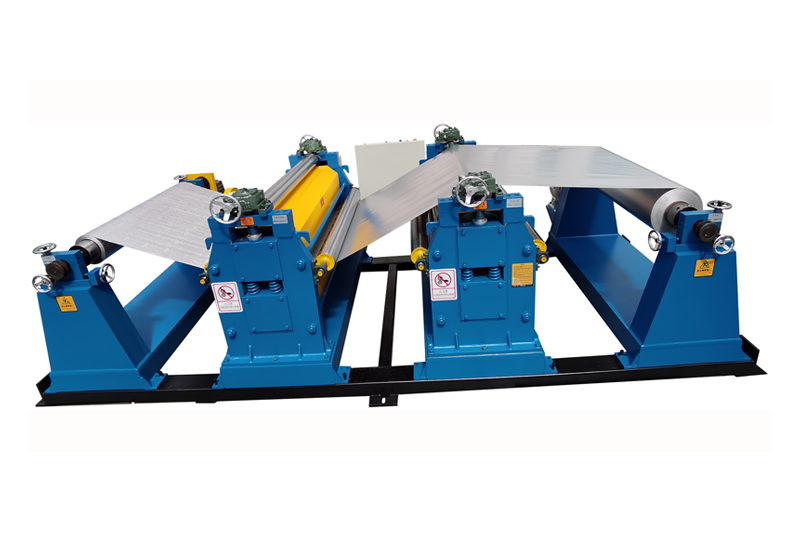


Ten Key Processes Affecting Embossing Steel Roller Quality
Published: 2026-07-16 09:28:29
The precision, circular runout, pattern definition, service life under abrasion and high-speed running stability of finished embossing steel rollers are fully determined by the following ten manufacturing processes. Errors arising in any working procedure may directly lead to roller scrapping, inconsistent pattern depth on embossed products, roller vibration and tool chatter, susceptibility to deformation and abrasion, and other defects.
1. Raw Material Preparation
Process Details
The roller barrel adopts seamless steel pipe; the roller shaft uses 45# round steel; end plates are made of Q235 steel plate. Materials are cut according to drawings with an 8 mm machining allowance reserved, and the initial uniformity of pipe wall thickness is controlled.
Quality Impact
Uneven wall thickness: Large radial thickness deviation after turning triggers eccentric vibration at high speed and uneven embossing pressure;
Insufficient machining allowance: Dimensional errors cannot be eliminated in finish machining; out-of-tolerance roller length or diameter makes assembly impossible;
Incorrect or inferior material selection: Weld cracking, thermal treatment deformation, and roller shaft bending during operation.
2. Component Pre-Assembly & Internal Structure Welding
Process Details
Stiffeners and inner sleeves are installed inside the roller barrel. The inner end plates are welded first, with continuous calibration to ensure coaxiality between both shaft ends and the inner sleeve. Unilateral offset welding is strictly forbidden.
Quality Impact
Coaxiality deviation causes inherent roller eccentricity, which cannot be completely eliminated by subsequent finishing operations. Cold welding or poor welding quality leads to leakage of water/oil channels and roller cracking under pressure. Insufficient welding of stiffeners results in indentation of the roller barrel under load.
3. Inner & Outer End Plate Assembly and Welding
Process Details
Fit the inner sleeve into the roller barrel and weld the inner joint seam. Then mount the outer end plate and perform full penetration welding on joints among the shaft, end plate and roller barrel to guarantee full weld beads free of slag inclusion and air pores.
Quality Impact
Weld stress concentration causes overall roller bending; weld porosity and cracks lead to weld fracture under heating. Misalignment between end plates and roller barrel shifts the machining reference for subsequent bearing seat processing.
4. Post-Weld Stress Relief Annealing
Process Details
The entire welded rough workpiece undergoes constant-temperature furnace annealing to release residual internal stress generated by welding and assembly, followed by slow cooling to eliminate deformation tendency.
Quality Impact
Skipped or improper annealing is the primary cause of deformation of finished steel rollers. The roller gradually bends during storage or high-temperature service after finishing, causing persistent radial runout. Unrelieved internal stress triggers spontaneous deformation during turning and engraving, resulting in inconsistent embossing depth.
5. Datum Positioning and Center Hole Machining
Process Details
Level the end face of the roller shaft and drill high-precision standard center holes for tailstock tips. These holes serve as the unified machining datum for subsequent turning, engraving and dynamic balancing.
Quality Impact
Eccentric, uneven-depth or damaged center holes offset the machining reference for all downstream processes, leading to batch non-compliance of coaxiality and roundness. Unstable tip positioning generates chatter marks during finish turning and engraving.
6. Rough and Finish External Cylindrical Machining
Process Details
Rough turning removes excess stock, and finish turning machines the workpiece to final dimensions. The surface roughness of the roller working face is controlled ≤Ra1.6μm; radial runout of working surface ≤0.025mm, roundness tolerance 0.036mm. Bearing seats are machined to k6 tolerance; steady rests are adopted for finish machining of end faces and mounting holes.
Quality Impact
Excessive radial runout: Severe vibration during high-speed operation on machine tools, forming periodic transverse stripes on embossed sheets;
Poor roller surface roughness: Low adhesion of subsequent chrome plating with high risk of peeling;
Out-of-tolerance precision of bearing positions: Excessive assembly clearance causes roller shaft shaking, equipment abnormal noise and embossing offset.
7. Static Balancing Calibration
Process Details
Mount semi-finished workpieces after finish turning for static balancing via weight addition and removal to eliminate eccentricity caused by self-weight of the roller barrel.
Quality Impact
Static balancing omission results in obvious vibration even at low speed and intense shaking in high-speed production. It not only distorts embossed patterns but also accelerates wear of equipment bearings and frames. Long-term eccentric load easily triggers roller shaft fracture. High-end embossing rollers require additional dynamic balancing testing, which can limit coaxiality within 0.02 mm.
8. Precision Roller Pattern Engraving (Core Critical Process)
Process Details
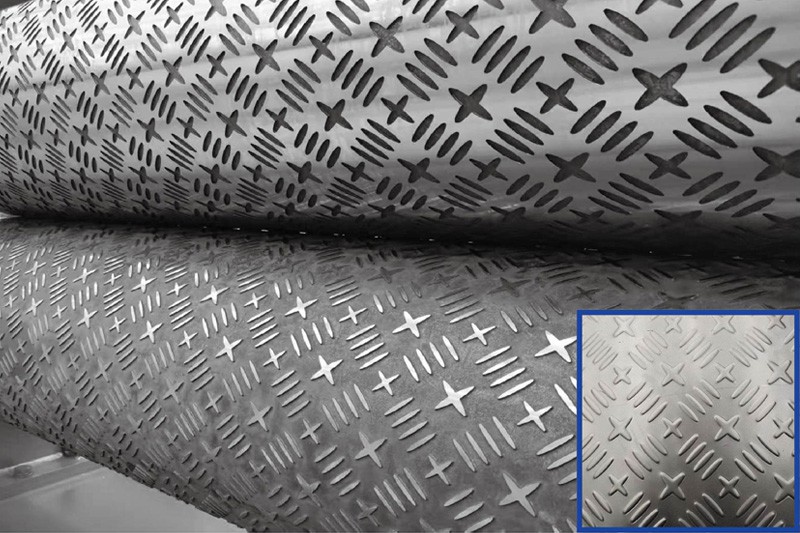
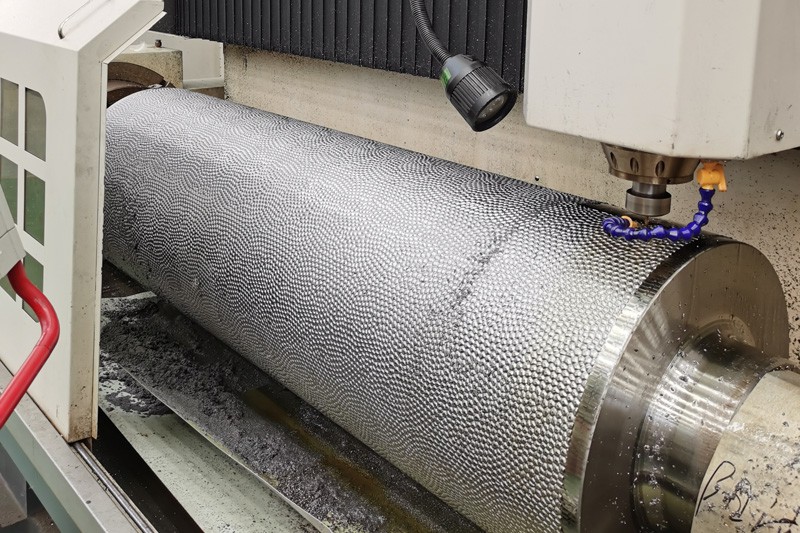
Based on engineering drawings or 3D models, three mainstream methods including CNC milling, laser etching and chemical etching are adopted to engrave concave-convex patterns. Strict control is implemented for pattern depth, pitch, edge sharpness and stitching tool marks.
Quality Impact
Uneven engraving depth: Variable pattern depth on finished products and drastically reduced yield rate;
Obvious tool stitching marks: Linear hard imprints left on embossed surfaces;
Excessively large heat-affected zone of laser engraving: New stress formed on roller substrate leading to local deformation;
Inadequate cleaning after chemical etching: Residual etching liquid creates hidden risks of substrate rusting.
9. Hard Chrome Plating Surface Reinforcement
Process Details
Complete overall polishing pretreatment after pattern engraving, followed by hard chrome electroplating with coating thickness of 0.03~0.05 mm. The surface hardness reaches HRC58~62 after hardening to upgrade wear resistance, rust resistance and scratch resistance.
Quality Impact
Insufficient chrome thickness: Poor wear resistance; pattern edges become blunt after short-term service resulting in fuzzy embossing;
Excessively thick chrome layer: Tiny pattern gaps are filled with chrome, losing delicate texture details; high internal stress inside the chrome layer causes peeling and spalling;
Incomplete degreasing and rust removal in pretreatment: Local chrome peeling and pitting corrosion on roller base metal.
10. Final Full-Item Inspection and Finished Product Polishing
Process Details
Retest roller diameter, overall length, coaxiality, circular runout, pattern dimension and chrome layer adhesion. Polish and trim local burrs and issue factory inspection records.
Quality Impact
Unchecked dimensional out-of-tolerance before delivery leads to assembly failure on customers’ embossing machines. Unprocessed pattern defects and burrs scratch metal sheets, plastic films and leather substrates during embossing. Lack of adhesion sampling inspection may cause coating peeling in early production and mass product rejection.